Loading...
Serving Newark, CA and surrounding areas. (510) 561-1564
Adding a deck, an addition, or a retaining wall? Your project starts below ground. We pour concrete footings in Newark engineered for clay soils, permitted through the city, and inspected before the concrete is ever poured.
Concrete footings in Newark are the underground concrete bases that hold up structures - a deck, a room addition, a fence, or a retaining wall - with most residential projects taking one to two days of active work and two to four weeks total once permits and the curing period are factored in.
Think of a footing as the feet of whatever you are building. If they are solid, properly sized, and placed on stable ground, everything above stays level and secure for decades. In Newark, that part matters more than in most places - the clay-heavy soils under much of the East Bay flatlands expand and contract with the seasons, and a footing that was not designed for that movement will shift over time. Concrete footings in Newark also have to account for seismic forces near the Hayward Fault, which means more reinforcement inside the concrete than you would need in most other states. If your project also involves foundation or floor-level work above the footings, our foundation installation service covers what comes next.
The City of Newark requires permits for most footing work tied to decks, additions, and retaining walls. That permit process includes a city inspection before the concrete is poured - which is actually a benefit, not a burden, because it means an independent set of eyes verifies the work before everything is buried and invisible.
If you can see a gap opening between your deck and the house, or if the deck surface is no longer level, the footings underneath may have shifted or deteriorated. In Newark's clay soils, this kind of movement often happens gradually over years as the ground expands and contracts with the seasons. Do not wait until the structure feels unsafe.
Any time you add a deck, a covered patio, a room addition, or a substantial retaining wall, you will need new footings before the project can start. Newark's building department requires it as part of the permit process. Getting a footing assessment early helps you understand the full scope and cost before you commit.
Horizontal or diagonal cracks near the base of a fence or wall often mean the footing below has moved or failed. This is especially common in Newark's older neighborhoods where original footings may have been shallow or undersized. A crack that is getting wider over time is more urgent than one that has been stable.
If a fence post, deck post, or support column moves when you push it, the footing holding it in place has likely failed. In the Bay Area's wet winters, moisture can work its way into older footings and accelerate deterioration, especially if the original concrete was not properly mixed or cured. A wobbly post means the structure above is no longer properly supported.
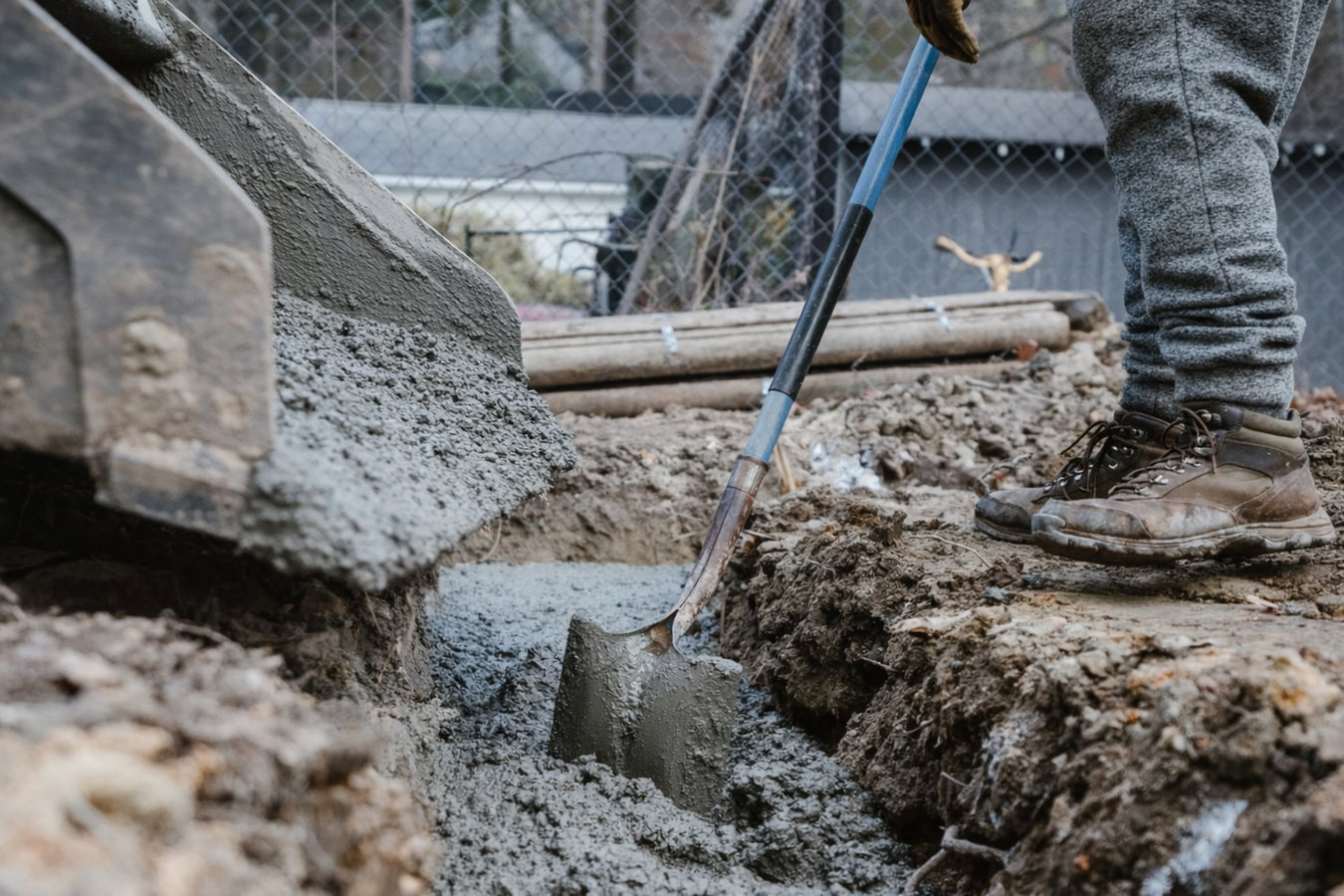
Every footing project starts with a site visit where we assess your soil conditions and confirm the correct depth and width for what you are building. We pull the required City of Newark permit, coordinate the pre-pour inspection, and handle the dig, forming, rebar placement, and pour. After the concrete cures, we haul away the excavated soil and leave the area clean. If the project involves a larger structural element above the footings - like a new foundation slab or floor system - we can connect that work directly into our foundation installation service so the entire below-grade scope is handled consistently.
We also handle footing replacement on existing structures - decks, fences, and retaining walls where the original footings have shifted or failed. This requires assessing whether the structure above can be temporarily supported during the work, which we confirm during the site visit. For larger projects involving significant foundation lifting or adjustment, our foundation raising service addresses that scope. Every footing we install includes steel reinforcement sized for the load and the seismic requirements of the Bay Area.
Best for homeowners building or replacing a deck, covered patio, or front porch where new footings are required by the city permit.
Best for homeowners adding square footage to their home - where the new structure needs footings tied into or adjacent to the existing foundation.
Best for properties where fence posts have failed, a retaining wall is planned, or an existing wall has cracked at the base.
Best for Newark properties built in the 1950s through 1970s where original footings were built to older standards and have shifted with the soil.
Newark sits on the East Bay flatlands where clay-heavy soils are common. Clay soil absorbs water and expands during the rainy season, then shrinks as it dries in summer - a cycle that repeats every year and puts real stress on footings that are not deep or wide enough to handle it. This is not a theoretical concern: it is the reason decks on older Newark properties tilt over time and why fences on clay-heavy lots need replacement footings sooner than the fence boards themselves. The California Building Standards Commission sets the codes we work to, and those codes specifically address soil conditions like those found across Alameda County.
The seismic environment adds another layer. Newark is close to the Hayward Fault, and California's building code requires that footings for structures attached to your home be designed to resist lateral earthquake forces, not just the weight of the structure above. That means more steel reinforcement and a more thorough inspection process than you would encounter in most other parts of the country - and a contractor who does not mention seismic requirements for attached structures in the Bay Area is not giving you the full picture. We work regularly in Hayward, CA and Fremont, CA, where soil and seismic conditions are closely comparable, which means we bring direct regional experience to every Newark project.
Tell us what you are building, roughly how large it is, and whether you have already spoken to the city about permits. We will respond within one business day to schedule a site visit - because footing depth and width cannot be determined without seeing your specific soil conditions.
We assess soil conditions, confirm footing dimensions, and provide a written estimate that includes the permit fee. Once you approve, we file the permit application with Newark's Community Development Department - typically a few days to a week before work can begin, depending on city workload.
We excavate to the required depth, set the forms, and place steel reinforcement inside. Before any concrete is poured, a city inspector verifies depth, width, and rebar placement - this inspection is required and typically takes less than an hour once scheduled.
Once the inspection is approved, we pour the concrete and apply curing protection suited to the season. Plan for at least seven days before any construction begins on top. We haul away excavated soil and leave the site clean. Final city inspection, if required, is scheduled and managed by us.
We visit your property, assess soil conditions, and give you a written quote that includes the permit fee - no obligation, no guesswork.
(510) 561-1564We file the City of Newark permit, coordinate the pre-pour inspection with the city inspector, and handle any final inspection required at the end. You never make a single call to the city, and the finished work is fully documented and code-compliant.
Newark's clay-heavy soils require footings that go deeper and wider than generic national standards suggest. We assess your specific site conditions before quoting and size every footing to account for the seasonal movement this ground is known to produce.
Every footing we install for an attached structure includes the steel reinforcement required by California's seismic building code. The American Concrete Institute sets practice standards we follow on every pour - see{' '}<a href='https://www.concrete.org' target='_blank' rel='noopener noreferrer' className='underline'>ACI</a>{' '}for those guidelines.
California law requires contractors to call 811 before excavating so underground utilities are marked. We do this on every job without exception - it protects your yard, your utilities, and the crew. If your contractor does not mention this step, ask.
For footing work, what you cannot see after the job is done is what matters most - and that is exactly why we welcome the city inspection before the pour. You are not just taking our word for it: the city signed off on the depth and reinforcement before the concrete covered it up.
Lifting and releveling an existing foundation when soil movement or settling has caused structural problems beyond what new footings alone can fix.
Learn MoreComplete foundation work for new construction or additions where the full below-grade structural system needs to be built from scratch.
Learn MorePermit slots fill up before summer - lock in your start date now so your deck or addition stays on schedule.